

Programmatic advertising involves using computer software to automate the buying and selling of digital ads. Most programmatic ads are sold using the CPM (cost per thousand impressions) model and are generally less expensive than direct purchases.
These ads can be bought with either a fixed or dynamic CPM model.
A fixed CPM is a static rate paid for every 1,000 impressions, often used for private marketplaces or direct deals.
In contrast, a dynamic CPM allows advertisers to set a price range for individual impressions, with the rate varying based on the impression’s value and campaign optimization.
Direct vs. Programmatic Advertising:
In direct advertising, prices are negotiated and based on a fixed CPM, with no auctions involved.
In contrast, programmatic advertising allows advertisers to either:
Bid on impressions through real-time auctions, or
Purchase guaranteed ad impressions directly from publishers.
It helps to automate the process of buying and selling media.
Ad spaces are traded programmatically through Ad Networks and Ad Exchanges, and this is the opposite of a manual media buying approach.
Most of the processes are handled by algorithms and computers.
So, advertisers and publishers can use advanced technologies, tactics, and methods to achieve their goals in a more effective and efficient way.
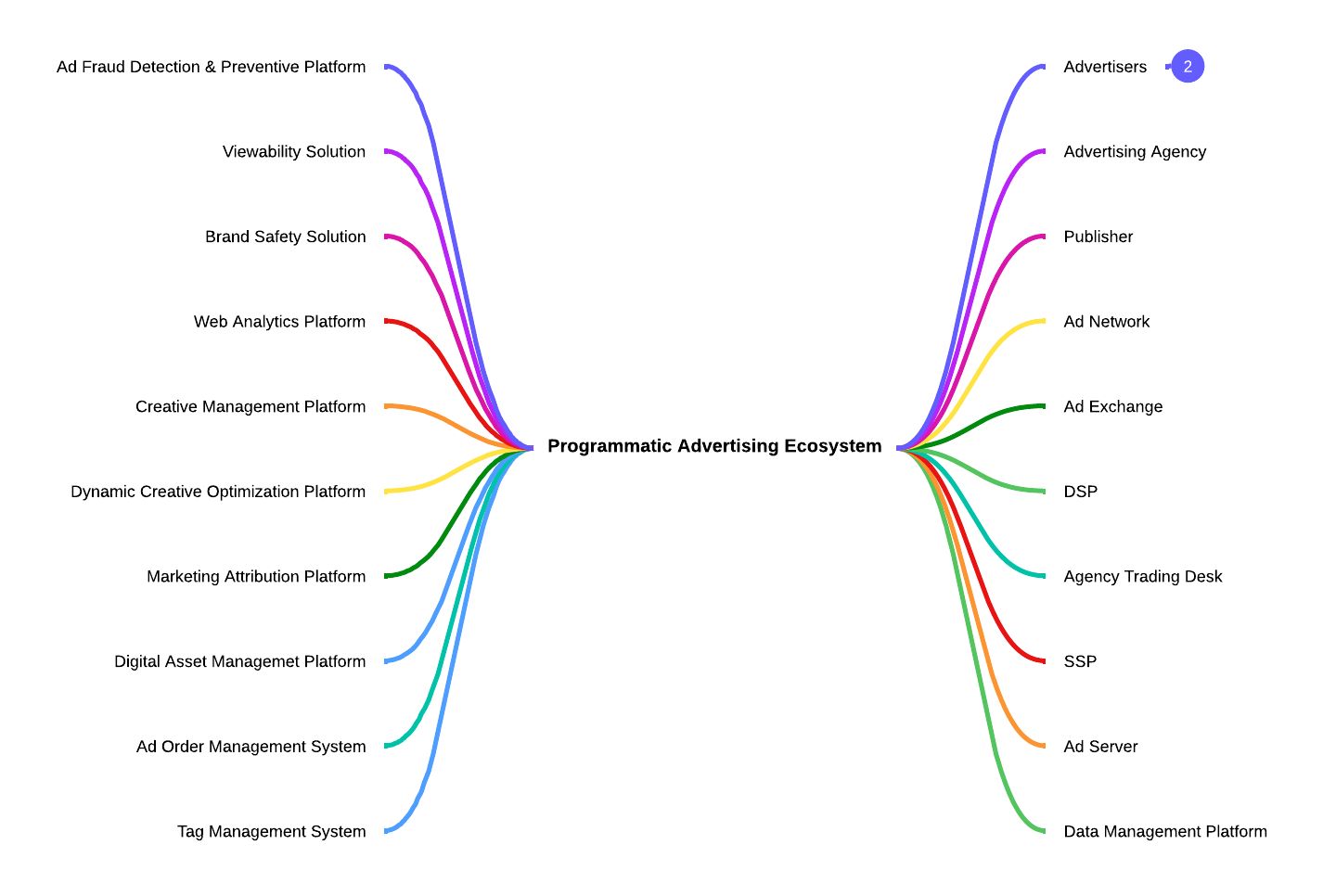
The most important thing to understand programmatic advertising is to understand its ecosystem—how to combine different technologies to run highly sophisticated campaigns.
In the Programmatic Advertising Ecosystem, there are many participants, and each of them has their own role.
For now, we have discussed it in a general way.
Later, we will discuss every participant, including the DSP (Demand Side Platform).
Below, the mind mapping picture shows some of the participants of Programmatic Advertising that make up the ecosystem of Programmatic Advertising.